Background and aim:
Tuberculosis (TB) is a highly infectious disease and a leading cause of death worldwide. About 10 million people fall ill with TB every year. Treating the diseases also poses significant challenges, particularly in terms of delivery of the drug to children, the associated hepatotoxicity that arises, and adherence to the therapeutic regimen.
Nanoparticle-based strategies have demonstrated promising outcomes for chronic infectious diseases and may provide an effective and robust delivery system to improve the efficacy of anti-TB drugs.
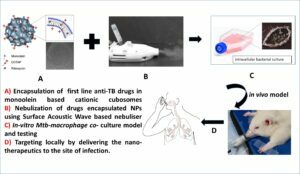
The overarching aim of this project was to combine the delivery capabilities of novel nanoparticulate drug delivery systems with an advanced nebulisation platform that allows further targeting by locally delivering the drug directly to the site of infection. This is particularly useful for childhood TB as the majority (>80%) of childhood TB cases are pulmonary (unlike its adult counterpart where the disease can be disseminated across extra pulmonary sites). Such local targeting to the disease site is not only expected to reduce the dose required, thus increasing the efficacy while reducing the time and cost of treatment, but also reduces side effects associated with systemic treatment, including toxicity effects on the liver. Moreover, inhaled delivery offers the benefits of a low-cost non-invasive self/home-administration that improves patient comfort and compliance.
Results/outcomes:
A) A state-of-the-art Tuberculosis-PCII laboratory was setup at the RMIT Bundoora west campus in Melbourne by Dr Sampa Sarkar. The potential of monoolein (MO) based cubosomes for the encapsulation and delivery of single anti-tubercular drugs (rifampicin, ethambutol, isoniazid, pyrazinamide and streptomycin) evaluated against Mycobacterium Tuberculosis (M.tb) H37Ra and H37Rv in-vitro culture model.
B) Rifampicin encapsulated in cubosomes had a significantly greater killing effect as compared to the free drug and has the potential to shorten the lifecycle duration of axenic tb H37Rv. This could reduce the dosage frequency and potentially resolve the difficulty of poor patient compliance due to prolonged TB drug treatment regimes.
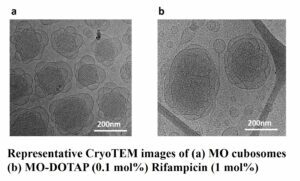
C) Drug-encapsulated cubosomes (developed by Dr Sampa Sarkar) were successfully nebulised using a novel Surface Acoustic Wave (SAW) based patented nebulisation platform (developed by Prof Leslie Yeo), exemplifying the potential of these systems for inhaled drug therapy. The internal structure of these systems was investigated using high-throughput Small-Angle X-ray Scattering (SAXS) at the Australian Synchrotron (by A/Prof Charlotte Conn and Dr Sampa Sarkar). The internal cubic nanostructure of these nanoparticles was retained and increased the bioavailability of the poorly water-soluble anti-TB drugs, rifampicin and isoniazid, compared to their previously reported activity against mycobacteria. The efficacy of these lipid-drug nanomaterials at killing the tb. H37Rv strain was highly drug dependent. For the hydrophobic drug rifampicin, the efficacy of the cubosome encapsulated drug was shown to be better than that of the free drug.
D) Furthermore, the nebulisation platform was used to disperse cubosomes into an aerosol. The internal nanostructure of the cubosomes before and after nebulisation was assessed using SAXS. The internal nanostructure of nebulised cubosomes loaded with the rifampicin and isoniazid was also characterised using SAXS. In both cases the cubosome structure was shown to be stable following nebulisation. The stability of the cubosome nanostructure under SAW, including with drug encapsulated, is highly promising for the application of these nanoparticles for inhaled TB drug therapy.
E) This technology will be further used for in vivo studies to assess the efficacy of traditional cubosome injections, and inhalation therapy using nebulised cubosomes, for the treatment of TB, including drug-resistant TB.
Bigger picture:
By demonstrating the possibility for delivering encapsulated anti-TB drugs via inhalation with a personalised delivery device, it anticipates the opportunity to:
-Enhance the efficacy of drug delivery for treating pulmonary TB by increasing the local concentration where it is needed; Lower the dose required and reduce systemic side effects and hepatotoxicity; Improve patient comfort and compliance.
-Decrease the overall treatment and preventive therapy time (current time 9 months and 6 months, respectively).
-Given that the nebulisation platform is generic, we expect that validation of this technology in this project could also open up further therapeutic applications across a wide range of pulmonary diseases such as COPD/asthma, cystic fibrosis, influenza vaccination etc.