
It is now recognised that eating ‘junk’ foods that are high in sugar or fat change the way the brain functions. Dr Furlong’s research has shown that when rats have access to sweetened-condensed milk, they will readily consume it, and that their brains and behaviour are also changed compared to rats that have healthy diets. Specifically, rats that eat junk food were found to continue to press a lever for a sugary pellet even when they no longer desire that food. Normally when rats (and humans) have eaten enough of a particular food, they will no longer want that food and stop eating it! However, when rats have a junk food diet, they will keep pressing a lever to get more junk food even when they have over-eaten on that exact food. Dr Furlong’s research aimed to determine what goes wrong in the brain to cause this over-eating, and to see if it could be stopped with a drug (that might then one day be given to humans to stop habitual eating).
Dr Furlong’s research determined that a drug which targets a chemical in the brain called orexin will stop this poor control of feeding behaviour. Orexin is a chemical that controls normal feeding, and Dr Furlong believes that high-calorie diets change the way orexin functions and this results in over-eating. Rats were given a junk food diet and this resulted in a loss of control of feeding. They were then then allowed access to a lever that they could press in order to get a sugary pellet. However, right before giving them access to the lever, they were given an injection of a drug that stops the orexin chemical, or a placebo drug that would have no effect on their brains. It was found that whilst the rats that received the placebo drug pressed the lever a lot (even though they shouldn’t have wanted the sugar pellet as they just ate a lot of it!), the rats that received the orexin drug reduced responding on the lever. In fact, their level of responding on the lever was the same as rats that had the healthy diet, so it was concluded that blocking the chemical orexin will restore normal feeding behaviour in rats.
For the next part of the study, Dr Furlong wanted to determine where in the brain that orexin might be acting to have its effects. The drug that stops orexin was injected directly into the brain into a region called the midbrain. The midbrain was chosen because this is where the chemical dopamine is made. Dopamine is a chemical that is known to be important for experiencing the rewarding effects from food, so it was thought that orexin may be interacting with dopamine to alter normal feeding behaviour. When the orexin drug was injected into the midbrain, it was found that it restored normal feeding behaviour in rats after they had junk food. This shows that the chemical orexin is interfering with the normal functioning of dopamine, and that stopping orexin allows dopamine to function normally again. It also shows that the brain circuits that control feeding normally and what might be done to restore normal feeding behaviour in humans.
Several follow up studies were conducted to confirm that research is indeed focusing on the correct brain regions and brain chemicals. The above studies stopped orexin from working after it was made by the brain. Different drugs were used to confirm that abnormal feeding behaviour could be stopped by stopping orexin being made by the brain, and also by stopping the brain from making dopamine. The drug used to target orexin is actually a very modern technique which interferes with the brains genetic information to stop it making orexin. The image below is a photo of the brain. The brain cells that make orexin are labelled with red colour and the drug is green. When the drug stops orexin from being made there are no more red brain cells (and no orexin!) and when the placebo drug is injected it doesn’t stop orexin so you can see both orexin cells (red) and cells that have taken up the drug (green).
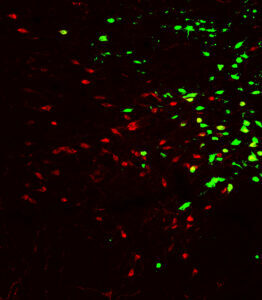
So stopping orexin from being made, restored normal food seeking behaviour in rats. The same effect was achieved by stopping dopamine from being made, with a different drug called 6-hydroxydopamine. Hence, Dr Furlong showed that both orexin and dopamine are important in regulating food intake, and that targeting these chemicals may be a way to restore normal behaviour. The goal would be to develop these drugs further so that they are safe for human use to stop the vicious cycle of over-eating that occurs once you have a bad diet.
This research has improved our knowledge of what goes wrong in the brain to cause over-eating, and will hopefully increase available options of drugs that will stop people from undesired over-eating.