The Rebecca Cooper Medical Research Foundation Project Grant awarded to Dr Foldi allowed the development and subsequent purchase of the world’s first, fully automated touchscreen cognitive testing system for rats. This system completely eliminates experimenter intervention by connecting a home cage to a touchscreen testing chamber via a series of tunnels and computer-controlled gates. Preliminary data indicates that, compared to conventional touchscreen testing, the use of this system increases the rate of learning complicated tasks by up to 10-fold, which opens the door to a whole range of previously impossible applications in behavioural neuroscience.
Dr Foldi’s recent research has, for the first time, identified a neural circuit involved in cognitive flexibility, the ability to modify behaviours in the face of changing environmental demands, that is also involved in the development of pathological weight loss in the ABA model. Since cognitive inflexibility is a common feature in patients with anorexia, as well as many other psychiatric conditions, this was a necessary first step in the process of findings targets for novel therapeutics.
Dr Foldi is now focused on examining how psilocybin, the psychoactive compound produced by “magic mushrooms” acts on this neural circuit and whether it can be harnessed as a therapy for treating the cognitive inflexibility that characterises anorexia. Psilocybin has been trialled in other conditions that involve a level of cognitive inflexibility, such as treatment resistant depression, with remarkable success.
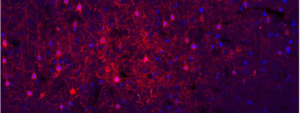
The photo below shows neurons in the circuit manipulated in the study (Prefrontal cortex neuron; red) with a marker for activation (cFos) in blue.