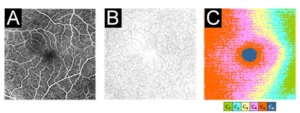
Dr Nivison-Smith and her team aimed to use novel techniques to better classify individuals with age-related macular degeneration (AMD). This would help identify those at greatest risk of vision loss from the disease and ensure they received timely and appropriate intervention. This is critical as AMD affects 200 million worldwide and is growing with the aging population.
Using the novel technique, Pattern Recognition to better analyse images of AMD eyes
Dr Nivison-Smith and her team previously showed that pattern recognition can combine results from multiple devices used in AMD testing into a single image for easier interpretation. They further demonstrated that:
- pattern recognition can differentiate between two highly similar AMD lesions: drusen and pseudodrusen. This is significant as although they appear similar, pseudodrusen are associated with worse patient outcomes and should be monitored more closely.
- Pattern recognition can track drusen size over time better than current commercially available software. This is significant as increasing drusen size signals worsening disease, but it is difficult to detect with the naked eye.
Using the novel technique, high density analysis, to detect undiscovered changes in AMD
Dr Nivison-Smith’s team hypothesised that new disease changes may be found if more accurate, high density analysis was conducted on images of AMD patient eyes. They found:
- High density analysis of OCT images (cross-sectional images of retina) shows AMD causes changes to the inner retina. This is significant as AMD was thought to only affect the outer retina and suggests the whole retina requires monitoring
- High density analysis of retinal blood vessels shows some vessels are affected by AMD while others are spared. This is significant as it may help predict development of new retinal blood vessels which can lead to blindness
Using the novel testing parameters to detect changes vision in AMD
Dr Nivison-Smith’s team previously found modifying certain parameters used in perimetry (a technique to measure a person’s visual field) can indicate changes in vision in AMD that were previously undetectable. They furthered this work by:
- Performing a systematic review showing standard perimetry is not useful for assessing early stages of AMD. This is significant as it provides clear, evidence-based advice to clinicians.
- Generating a research dataset of AMD eyes tested with a variety of perimetry conditions. This is significant as this data set can be used to determine the best perimetry method to use for AMD
This research confirmed these novel strategies enhance our understanding of AMD and provide improvements to assessment of AMD in medical practice. Considering AMD is a leading cause of blindness worldwide, these benefits will affect a significant population.