Dr Quinn and her team have tested whether age-related biomarkers in healthy younger and older human donors and older multiple myeloma patients can predict the outcome of a new therapy called CAR T cell therapy.
Currently, CAR T cell therapy in the clinic uses two different approaches to activate a patient’s immune cells- one that targets a molecule called CD3 and another that targets both CD3 and another molecule called CD28.
Dr Quinn’s research has shown:
• For older individuals, particularly those with multiple myeloma, targeting CD3 alone is optimal and targeting both CD3 and CD28 is counterproductive. This is consistent with other emerging datasets and will aid selection of optimal selection of CAR T cell therapy approaches in the clinic.
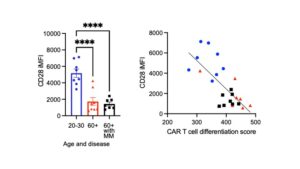
• CD28 can be used as an age-related biomarker to identify patients that are more likely to respond well to CAR T cell therapy approaches that target CD3 and CD28.
Dr Quinn and her team are currently evaluating a range of other age-related biomarkers in healthy donors and multiple myeloma patients. Samples from multiple myeloma patients are being compared prior to and after bone marrow transplantation. This data will inform whether samples for use in CAR T cell therapy should be collected before or after bone marrow transplantation, a key unresolved issue in the field.
Dr Quinn and her team are also investigating the impact of Bcl-2 inhibitors, p38 inhibitors, and IL-15 stimulation in an aged mouse model. Unfortunately, Bcl-2 or p38 inhibition has not significantly impacted CAR T cell generation to date, but there is promising data with IL-15 stimulation that will extend into complementary human assays.
The data below demonstrates the difference in CD28 expression between younger or older healthy donors and older donors with multiple myeloma (MM) (left) and the correlation between CD28 expression and the “differentiation score” of CAR T cells made from those donors, which is used as a measure of the quality of the cells, across age and patient groups (right).
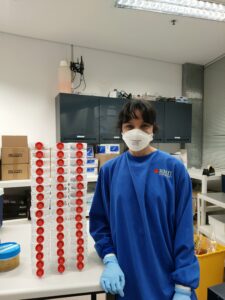
Below, Palak Mehta stands beside 48 flasks of CAR T cells generated from cells. These CAR T cells were used to gather a big dataset for ageing and CAR T cell research.