RNA treatments have great potential to change how we prevent and treat retinal diseases. Their success mostly depends on a good delivery system that can protect the RNA from breaking down, help it enter cells, and allow the release of the genetic material. Tiny fat particles, called lipid nanoparticles (LNPs), have become a popular delivery system because they work better, target specific cells, reduce harmful side effects, and last longer. However, we still don’t fully understand how these LNPs interact with cells, which has made it harder to use them for delivering RNA to retinal cells efficiently.
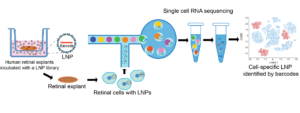
To tackle the problem, Dr Zhang’s team made a collection of LNPs, each with a unique genetic barcode. These LNPs were mixed with a piece of post-mortem human retinal tissue, allowing genetic barcodes wrapped in LNPs to enter cells in the retina. Then the tissue was broken apart into individual cells. The genetic material inside each cell was studied using a technology called single-cell RNA sequencing. This helped to figure out how well different LNPs delivered their cargo into various retinal cell types based on their unique barcodes. To confirm their findings, Dr Zhang’s team loaded these LNPs with a glowing green substance (eGFP mRNA) and put them into human retinal tissue. 17 different LNPs were made with unique barcodes and the genetic material of over 10,000 retinal cells treated with the LNPs collection were studied. Nine different groups of retinal cells were found based on their unique transcriptomes, which represent all the known types of cells in the retina. The number of cells that were transfected by each genetic code carried by different LNPs was studied. The various LNPs had different preferences for delivering their cargo into different retinal cell types. Dr Zhang’s team confirmed how well the LNPs worked in human retinal tissue by looking at the green fluorescence proteins translated by the eGFP mRNA with different LNPs.
They also studied LNPs from Pfizer and Moderna that carry a special barcode using the screening system they established. Both types of LNPs could hold onto their barcode for at least 4 months, and they were able to package more than 70% of the barcodes inside them. Moderna LNPs got into more retinal cells than the Pfizer LNPs. Both types of LNPs mainly got into three kinds of retinal cells: rod photoreceptors, bipolar cells, and Müller glia. The Pfizer LNPs were 37% more likely to get into bipolar cells compared to Moderna LNPs. Moderna particles were 42% more likely to get into rod cells than the Pfizer particles.