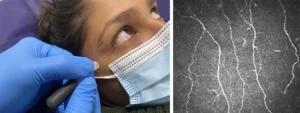
Diabetes is a leading global healthcare issue. Diabetic sensorimotor polyneuropathy is the most common complication, affecting >600K Australians. Optimal clinical care is hampered by several factors, particularly limitations of current diagnostic techniques, which have limited capacity to detect early-stage peripheral nerve disease, when interventions are most likely to be effective. Novel biomarkers with enhanced diagnostic resolution will improve this limitation.
A/Prof Downie’s approach to advancing care for people with peripheral neuropathy involves using the eye, in particular tear protein composition, as a non-invasive biomarker, for earlier detection. Notably, early-stage disease coincides with corneal nerve degeneration. Quantifying corneal nerves, using vivo confocal microscopy (IVCM), is a valid measure of nerve integrity that can identify peripheral neuropathy. Whilst corneal nerve IVCM is reproducible and non-invasive, a major drawback is high equipment cost and limited availability. An ideal diagnostic biomarker would be easy to measure, accurate and non-invasive. Tears are a complex biological fluid with unique capacity for biomarker interrogation. Tear neuropeptides are released from corneal nerve endings into the tears.
The aim of this project was to investigate tear neuropeptides as a novel method for diagnosing peripheral neuropathy in people with diabetes. It was hypothesised that tear neuropeptide levels would be lower in people with peripheral neuropathy, relative to controls, due to corneal nerve compromise.
The major finding was that concentrations of a specific protein (i.e., neuropeptide) are significantly lower in the tears of people with diabetes and early-stage neuropathy, relative to age-matched healthy controls. This discovery identifies neuropeptide levels in tears as a potential novel biomarker, to support the early detection of peripheral neuropathy in people with diabetes. The diabetes group also had reduced corneal nerve fibre density compared to controls, suggesting that reductions in tear neuropeptide levels parallel corneal nerve loss in early neuropathy. Significance and outcomes: The identification of a tear neuropeptide as a new biomarker of diabetic peripheral neuropathy has an important role in the discovery and development of new treatments for early-stage disease. In the longer-term, this finding has capacity to support the development of a point-of-care device, based upon microlitre tear analysis, as a diagnostic tool and for objective monitoring of treatment efficacy in patients.