Common COPD-related toxic and therapeutic exposures can arrest autophagy, a fundamental cellular process required by all cells, and that is the primary intracellular bacterial clearance mechanism.
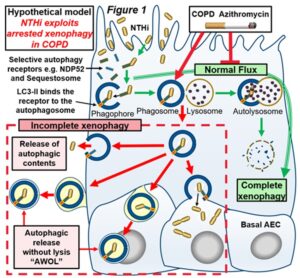
Dr Roscioli and his team investigated the process of microbial infection and autophagic blockade outlined in the Figure below. They determined azithromycin (AZM), which is frequently used to treat infection in COPD and is a top 10 globally prescribed antibiotic, blocks autophagy with remarkable potency. The consequences of NTHi surviving for prolonged periods in individuals who are frequently exposed to these antibiotics/therapeutics captures many of the world’s most immediate health priorities. Hence, restoring the cells’ own microbial clearance processes and safeguarding the efficiency of AZM is a pursuit of global importance.
To this end, Dr Roscioli generated a novel form of AZM. This form mitigates the off-target block in autophagy. Further AZM derivatives are now being synthesised that can be selected for anti-inflammatory and antibiotic effects. The ideal scenario is a next generation version of AZM that maintains anti-inflammatory properties, mitigates the block in autophagy, and from these, two version that are either antibiotic or non-antibiotic. The latter form will have extended benefits by providing the clinic a non-steroidal anti-inflammatory (exceptionally rare), that mitigates microbial resistance against conventional AZM. Importantly, these derivatives will allow the cells’ own bacterial clearance mechanisms to remain operative, when AZM is prescribed to patients with respiratory (and related) disease.
Fig 1: Autophagy (called “xenophagy” when directed to bacterial clearance) rapidly degrades intracellular bacteria via autophagy receptors that bind LC3-II in the phagophore (“xenophagic flux”; green arrows). Autophagy is dysregulated in COPD and is potently inhibited by AZM (e.g. Roscioli, 2020). These phenomena align with Dr Roscioli’s findings of NTHi within vesicles in the COPD epithelium. Dr Roscioli’s data shows extended disease-related phenotypes manifest as a result of arrested autophagy that enables NTHi to propagate between AEC, and like S. aureus, this may then allow a mode of transmission into the extracellular environment (“AWOL”) to infect adjacent cells (red arrows). This model is consistent with the incredible adaptive capacity of bacteria, and the increased selective pressure imparted by antibiotics, as humans live longer with disease.