Multiple sclerosis (MS) is a neurological disorder in which the insulating matter of nerves (myelin) is damaged due to the abnormal attack by a dysfunctional immune system. Current therapies target the immune system dysfunction and only few treatments aim to promote protection and repair.
A/Prof Castorina investigated the protective and regenerative properties of the two structurally-related neuropeptides, pituitary adenylate cyclase-activating polypeptide (PACAP) and vasoactive intestinal peptide (VIP). He also investigated the PACAP mimetic maxadilan in vitro and in an experimental model of MS.
The research focused on microglial cells, which are immune cells in the brain, and their response to inflammation. A/Prof Castorina found that two substances, PACAP and VIP, both had strong anti-inflammatory effects on these cells; however, each neuropeptide affected cell biology in distinct ways, with PACAP promoting key functions like scavenging and cell motility more effectively than VIP in microglia.
A/Prof Castorina conducted a meta-analysis of public datasets to identify genes altered in the white matter of people with various types of multiple sclerosis (MS). His findings were validated using brain samples from MS Brain Bank and Victorian Brain Bank. This study helped identify additional biological markers of MS severity.
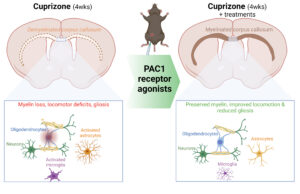
Using animal studies, A/Prof Castorina showed that treating mice with significant myelin loss with PACAP, VIP, or maxadilan improved motor function and reduced myelin and synaptic loss and inflammation in the brain’s white matter, as well as in primary brain cells.
These findings will set the stage for additional research, using genetically modified mice undergoing severe myelin loss, aimed at defining the exact mechanisms of these protective agents at cell resolution level; an essential step before the potential shift to clinical testing.