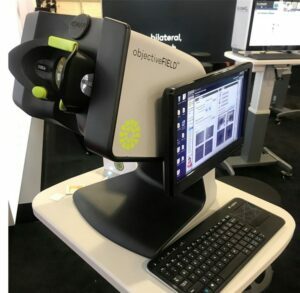
The most common cause of blindness in Australia is Age-Related Macular Degeneration (AMD), costing the Australian economy ~5 billion dollars annually. Current projections indicate that by 2030, 1.7 million people in Australia will have vision loss resulting from AMD. Macular pigment serves a protective role for AMD as a filter of short-wavelength light and in an antioxidant capacity to quench reactive oxygen intermediates. We have developed a new method for functional vision testing. The new method called multifocal pupillographic objective perimetry (mfPOP), assesses eye health from measuring changes in the way your pupil responds to light.
Currently, visual acuity is used to measure foveal function but it is a relatively imprecise measure. In particular, it does not identify retinal lesions threatening the centre of the macular. Consequently, changes in retinal structure and deposits in the macula have been used to predict a patient’s risk of progression to advanced AMD.
Dr Sabeti investigated changes in mfPOP responses in early AMD to potentially identify biomarkers for eyes at risk of progression. He collected data from 25 patients, 4 times each, with various severities of early AMD and is analysing the relationship between changes in eye function with changes macular retinal structure, and macular pigment density, to better understand the association between eye health and function. In addition, therapies for early AMD are developing, so there is a growing need for tools to monitor this early stage of maculopathy.
Figure: next-generation mfPOP device.