Endemic viral infections cause profound morbidity and mortality, with over 13,500 hospitalizations and >3000 deaths per year due to influenza alone (2.4% of total deaths in Australia). Respiratory viral infections are also implicated in half of community acquired pneumonia (CAP) cases. In adults, respiratory viral infection is associated with 30-50% of CAP cases, 80% of asthma exacerbations, and 20-60% of chronic obstructive pulmonary disease exacerbations.
Dr Wang and her team aimed to investigate whether inhibition of IL-22 signalling, via genetic deletion of the receptor, reduces lung pathology in pre-clinical models of bronchiolitis and asthma.
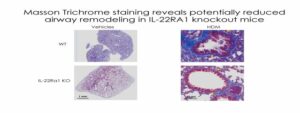
Among the three bronchiolitis asthma models, IL-22 receptor signalling deficiency only alleviated airway remodelling in mice challenged with house dust mite (HDM) allergen compared to wild type (WT) controls. Compared to HDM challenged WT mice which developed severe lung fibrosis, mice lacking IL-22 receptor signalling are protected from HDM induced asthma and lung fibrosis (Figure 1). The data suggests that IL-22 receptor signalling is playing a role in driving lung fibrosis in HDM induced asthma model.
However, the role of IL-22 receptor signalling in repeated viral infection induced bronchiolitis asthma are less clear and dispensable. Data indicates endogenous IL-22 may have different functions in the early stage of acute inflammation versus the later stage of tissue regeneration in viral infections and asthma. Therefore, therapeutic intervention of IL-22 needs careful consideration.
Figure 1. Mice lacking IL-22 receptor signalling had reduced lung remodelling compared to WT mice in house-dust mite (HDM) induced asthma model. Masson trichrome staining of paraffin embedded lung sections showing collagen deposition (indicated by yellow arrow) as a result of lung fibrosis in WT mice but not in IL-22Ra1 knockout mice.