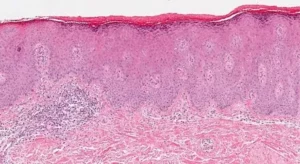
An understanding of the molecular triggers that initiate autoimmunity in psoriasis (PsO) patients would be a milestone for new therapeutic options, like desensitisation strategies that are successfully used in e.g., peanut allergy. Such a curative approach could provide patients with long-term, persistent PsO resolution. Immune responses are initiated by T cells recognising peptide antigens (protein fragments) bound to Human Leukocyte Antigen molecules (HLA). The variant HLA-Cw6 is an established risk factor for developing PsO and around half of the patients have this allotype. Concurrently, it is well-known that T cells play a major role in driving the disease. Dr Braun and her team hypothesised that particular microbial or self-derived peptides presented specifically by HLA-Cw6 and recognised by CD8+ T cells are at the root of aberrant immunity in the development and progression of PsO.
To close in on the peptide triggers of PsO, a library of around 30,000 skin antigens displayed by HLA-Cw6 in keratinocyte and melanocyte cell lines in vitro, was generated. A novel HLA-Cw6 transgenic mouse model was established and HLA-Cw6-restricted antigens isolated from psoriasiform skin as well as other organs ex vivo (~1,000 antigens). These two libraries now allow Dr Braun to probe immune responses against skin and skin cell line derived peptides to separate innocuous from pathogenic antigens. To this end, a clinical trial was set up to collect skin biopsies and blood from PsO patients. T cells were isolated to investigate whether a particular T cell receptor specificity is expanded in psoriatic skin. The introduction of expanded T cell receptors into a T cell line allows testing for their reactivity a) against the library of HLA-Cw6-derived antigens and b) in an unbiassed library approach.
Once broadly recognised immune targets are verified in the cohort of patients, tailored strategies to blunt or ablate deviant, pathogenic immune responses can be developed. To facilitate this, the HLA-Cw6 transgenic mouse model was further developed to a) lack murine molecules equivalent to HLA-Cw6 to reduce background and b) express human CD8 which allows the investigators to follow HLA-Cw6-restricted T cell responses. The model will be highly beneficial to test tolerance regimes against PsO antigens in vivo with the aim to contribute to developing a curative therapeutic approach in PsO which is currently lacking.