
Background: Chronic pain is a debilitating condition that affects 25% of people. The current frontline treatment, opioid medication, is highly problematic due to issues with addiction and loss of effectiveness over time. Dr Chew’s research goal is to solve the fundamental process by which repeated stimulation of pain receptor cells leads to increased excitability, a process called sensitisation, which is critical for the onset and duration of long-lasting pain. She aims to target the molecular and cellular changes that occur during pain receptor sensitisation in therapeutic strategies to treat chronic pain.
Research outcomes: The research approach is to use the highly accessible experimental brain, that of the nematode worm Caenorhabditis elegans, to uncover the brain network changes that result in pain neuron sensitisation. The project was divided into three parts:
Aim 1: To identify molecular/neurochemical regulators of pain sensitisation. Dopamine and two distinct neuropeptide pathways were identified as required to regulate pain sensitisation. Interestingly, it was found that dopamine suppresses sensitisation whereas the neuropeptides promote sensitisation. Dr Chew is currently resolving the exact brain regions that are activated to generate these opposing responses. With further exploration, Dr Chew hopes to test these neurochemicals as druggable targets to block sensitisation of both pathways in rodent models.
Aim 2: To reveal how different senses (touch, smell, taste) affect brain circuits that sense pain/noxious cues. Paradoxical conditions such as allodynia (pain in response to innocuous stimuli) and hyperalgesia (feelings of pain to non-painful stimuli) are both side-effects of opioids. Dr Chew aimed to identify how pathways that normally sense non-painful cues affect pain neural circuits. Gustatory (taste) pathways were paired with negative/noxious cues to test how they trigger changes in the nematode brain. It was identified that several molecular pathways known to affect learning/memory were required to encode the pairing between taste and nociception, as well as other uncharacterised molecules that are currently being investigated. Future research will test how these novel memory regulators affect pain circuits and if they can be targeted to prevent allodynia or hyperalgesia.
Aim 3: To visualize how pain circuits respond to dopamine signals in living animals. The data shows that dopamine suppresses pain sensitisation. Dr Chew aimed to visualise how dopamine acts on pain pathways during the process of sensitisation i.e. during repeated stimulation of pain receptor cells. A fluorescent dopamine sensor, previously only used in fly or mammalian laboratory models, was tested and showed for the first time that these sensors can detect dopamine in living worms. Dr Chew is currently using an optogenetic approach (using light to trigger dopamine release) to observe which cells in the pain neural circuit respond to dopamine signals, as well as the timing of these responses. Outcomes from these experiments will reveal the dynamics of how pain circuits desensitise in living animals, in real-time – and therefore which parts of the circuit can be targets for pharmacotherapy.
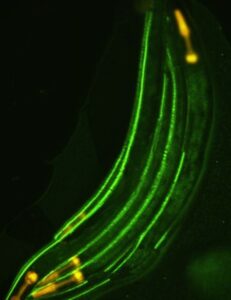
Worm strains expressing dopamine sensor (green fluorescence) in muscle cells