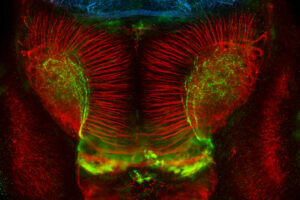
To confirm and study the pathogenic role of these risk-genes, Dr Giacomotto’s laboratory uses the zebrafish model which uniquely offers direct visual access to brain development and synaptic activity in living animals. They have been very successful in unveiling a possible pathogenic role for risk-genes such as miR-137 and NAPRT1 (Periyasamy et al. JAMA Psychiatry 2019), and have recently focused on studying the neurexin gene family. Neurexins have been repeatedly associated with both schizophrenia and autism. However, it turns out that those genes are extremely difficult to manipulate through traditional genetic approaches, thereby hampering the study of both their normal and pathogenic functions in the brain (Tromp et al. Molecular Psychiatry 2021).
With the support of a Rebecca L. Cooper Foundation Project Grant, Dr Giacomotto has developed a novel methodology to generate zebrafish models that present with a controllable level of neurexin in their bodies (Tromp et al., G3 Genes/Genomics/Genetics 2021) . This technological development has opened new research pathways by successfully generating transgenic and mutant lines. This material and methodology allows Dr Giacomotto to not only control the level of expression of the different neurexins in specific circuits of the brain but also to manipulate the non-coding sequences present across these genomic regions. This is very important as there is evidence in the literature that the role of those so-called “junk DNA” sequences (introns) in schizophrenia and other mental illnesses may have been underestimated. Indeed, those regions may carry key regulatory elements that have important functions in the biology of the diseases.
Based on the success achieved with his Rebecca L. Cooper Foundation funding Dr Giacomotto is now positioned to investigate and compare the roles of the different neurexins and associated regulatory elements in schizophrenia and other mental illnesses.