Summary of the aims and main findings:
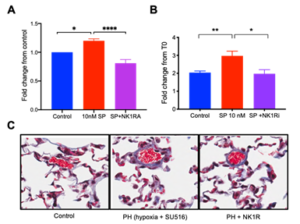
Aim 1. To elucidate the role of SP and NK1-R signalling in the pulmonary circulation. Using human pulmonary vascular cells in isolation it Dr Bubb and her team found that substance P has effects on key cell types. Firstly, it was found that substance P stimulates the formation of endothelial cell tubular networks, indicating it can increase angiogenesis (essential for growth of new blood vessels, Fig. 1A). Secondly, if was found that substance P stimulates the growth of smooth muscle cells (Fig. 1B), which is the layer of cells responsible for contracting and relaxing blood vessels. This means that substance P is likely to be involved in increased muscularisation of pulmonary blood vessels. Both muscularisation and dysregulated (out of control) angiogenesis are hallmark features of PH. These effects were blocked with an inhibitor of the main molecule that receives the signal from substance P (NK1R). Dr Bubb and her team are now in the process of finalising analysis of the pulmonary arteries from mice by looking at the structure and biochemical make-up.
Aim 2. Determine SP / NK1-R axis as a potential treatment in experimental pulmonary hypertension. PH was induced in mice, by a low oxygen environment (hypoxia), combined with a drug that caused vascular damage (SU5416). All mice were treated with either the NK1R inhibitor, aprepitant, to block the effects of substance P, or vehicle. Whilst blocking substance P did not have an effect on reducing the pulmonary artery pressure, it did protect against the development of pulmonary fibrosis and significantly attenuated the remodelling of pulmonary vasculature in PH (Fig 1C). Dr Bubb and her team will now work on optimising the dose of aprepitant or trialling this with other combinations of drugs to improve efficacy for pulmonary pressure.
Conclusion and Future directions:
It has been shown that substance P promotes cellular changes that are characteristic of PH and blocking of substance P can lower pulmonary fibrosis and vascular remodelling in PH. Dr Bubb and her team are in the process of establishing colonies of mutant mice deficient in substance P to further examine this in PH.