For over a decade, Associate Professor Luke Knibbs and his colleagues have studied how bacterial pathogens of greatest concern to people with cystic fibrosis (CF) can be transmitted through the air. They aimed to extend this knowledge by measuring the extent to which they can be inactivated by ultraviolet C light (UV-C). The project focused on Pseudomonas aeruginosa (Pa), the most prevalent lung pathogen in the CF community and a persistent infection control challenge for specialist CF centres worldwide, which care for hundreds of adults and children living with CF.
Since the commencement of this project in 2019, the debate and relevance of the role of airborne transmission has become prominent. The pandemic made it necessary to pivot the scope and reshape research to a greater focus on in‐vitro testing of aerosolised CF pathogens, in lieu of patient testing.
Detailed below are the project outcomes:
1. Undertaking a systematic literature review identified the evidence for, and limitations of, methods to limit airborne transmission of bacterial lung pathogens indoors.
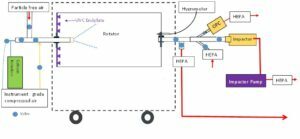
2. Building a customised UV-C sampling system to do the experiments in a controlled and consistent way
3. The effectiveness of UV-C light at inactivating nebulised airborne Pa (vs. no UV-C light) has been quantified in triplicate in an extensive series of laboratory chamber experiments.
4. Results suggest that relatively low levels of UVC increase the inactivation of airborne Pa. This has provided critical information that will inform the design and scope of future studies using ‘real’ human coughs.
5. The intention is to expand this program of research. Overall, it points to UV-C being worth consideration to complement methods like social distancing and face masks in CF clinics and other indoor settings where people with CF congregate.
Image: A schematic diagram of the system used in this study