Melanoma remains a significant and critical issue for Australians. With Australia having one of the highest melanoma incidences (>23,000 cases p.a.) and mortality rates in the world (1700 deaths p.a.) this is an area of significant need. Despite the unprecedented success of targeted and immunotherapies- many patients with advanced melanoma still die from recurrent disease and resistance to therapies. Targeted therapies are only effective in 35% of patients, and responding tumours rapidly acquire resistance to the therapy, with the patient subsequently succumbing to the cancer. Similarly, the overall response rate to immunotherapy is maximally 70% with many patients suffering potential long-term auto immune disease, and even here drug resistance has been reported. Thus, although melanoma has pioneered targeted- and immuno-therapies, there is still an urgent need for novel therapy approaches that can be combined with these therapies, offered as adjuvant therapies or as an option to those that currently have no clinical options.
As tumours proliferate uncontrollably, the focus of clinical therapies for cancer have concentrated on the development of effective cytotoxic drugs; drugs that stop tumour cell proliferation or initiate tumour cell death. This era of tumour biology has defined the key response criteria for therapeutic agents targeting solid cancers as a reduction in tumour size. However, an increase in the ability to invade being necessary for a tumour to spread or metastasize, and the association of morbidity with melanoma that has spread to essential organs (like the brain or lungs), there is a strong precedent to refocus our efforts design therapies against actively spreading tumour cells. This class of anti-metastatic and anti-invasion therapies would be called ‘Migrastatics’. Conceptually, Migrastatics would ideally be applied to early state (Stage II/III melanoma patients -those with thicker primaries, and/or regional lymph node metastasis/satellite/in transit metastasis), to delay or inhibit the spread of tumour cells to essential organs. Eventually, if successful it could even be applied in Stage I patients (thin primary melanomas).
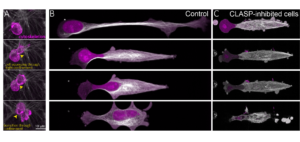
Cancer cells invade and spread to distal organs by squeezing between tight spaces such as tissues and surrounding cells. Cells do this via an intracellular structure called the cytoskeleton which forms a mesh-like network which acts like a girdle to control cell shape and movement. The research investigated a cytoskeletal binding protein called CLASP as novel therapeutic to target actively invading tumour cells. It was found that CLASPs are highly upregulated in melanoma. Surprisingly, when CLASPs are genetically inhibited, tumour cells catastrophically rupture when trying to squeeze through tight spaces. This decreases the invasive capacity of melanoma cells in pre-clinical tumour models (3D culture and organotypic matrices)- identifying CLASPs as potential therapeutic target to kill metastatic cells. Rupture of tumour cells in this manner is highly immunogenic- suggesting the future development of drugs that target CLASPs could be used in combination with immunotherapies to improve outcomes.
FIgure: (A) Melanoma cells invade through tissues by squeezing through the scaffold that surrounds them. This can be mimic’ed this using custom fabricated channels to image cells in a more controlled, detailed manner (B) When CLASPs are inhibited, tumour cells rupture (C) when they attempt to squeeze through as their protective cytoskeletal ‘girdle’ is destabilised – leaving them vulnerable to physical constraints from their environment.