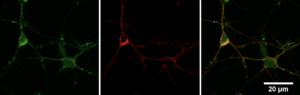
Diagnosis of neurodegenerative diseases including Huntington’s (HD) and Motor Neuron diseases (MND) is often delayed. Typical diagnosis based on clinical presentation and neuroimaging are usually ambiguous until the clinical syndrome is obvious. However, at this stage, the situation is often too late to reverse and thus leads to the failure of clinical trials for these diseases. Therefore, it is critical to develop new biomarkers that can report the changes at the early stage of these diseases for assessing presymptomatic disease risk and progression.
Dr Hong’s approach is to measure the effectiveness of the fundamental protein quality system in cells – proteostasis, which governs protein synthesis, folding, transport and degradation. Accumulation of unfolded proteins in the cells indicates proteostasis collapse. To measure the capacity of proteostasis, Dr Hong and collaborators have reported a new approach based on a novel small molecule, TPE-MI, to measure the level of unfolded protein load in the cells. TPE-MI is non-fluorescent until it reacts with unfolded proteins with an exposed reactive cysteine amino acid. The intensity of TPE-MI can thus be used to indicate the unfolded protein level as the measure of proteostasis capacity.
This research has expanded the toolbox of the biosensors towards the applications in the clinical settings.
Findings include:
1) TPE-NMI, a TPE-MI analogue that can be excited by visible light. This overcomes the problem of the original TPE-MI where a harmful UV light excitation is required. The new TPE-NMI is compatible with the most commonly used settings of fluorescence microscopy and flow cytometry. The finding “Tetraphenylethene for Imaging Unfolded Proteins in Cells” has been published in Chem. Asian J. 2019, 14, 904 and highlighted as the journal’s cover and the ChemistryViews Magazine.
2) NTPAN-MI, a TPE-MI analogue that overcomes the limitations of TPE-MI. It can image the unfolded protein not only in the cytoplasm but also in the nucleus, for the first time, which offers the opportunity to study nucleus proteostasis separately. It also possesses the ability to assess the local polarity of the unfolded proteins for the study of stress response in different samples. “Sensing Protein Wellbeing” has been published in Angew. Chem. Int. Ed. 2020, 132, 10215 and highlighted by a number of news media including Science Daily, EurekAlert! By AAAS, ChemistryViews and Innovations Reports.
3) TPE-EMI, a TPE-MI analogue that can be used to identify unfolded proteins in live cells. TPE-EMI fluorescence is able to distinguish three-four different stages of proteostasis collapse in cells expressing toxic proteins specifically for HD. Once cells of different stages are sorted, mass spectrometry proteomics will be used to identify proteins associated with these different stages. At the stage where protein inclusion is formed, the TPE-EMI fluorescence decreases drastically, confirming the role of inclusion formation in clearing proteostatic stress. We will further apply this probe in biopsy samples from individual with MND and healthy controls.
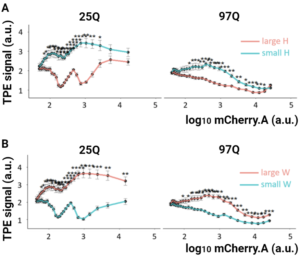
4) DPANzine, a probe that targets damaged proteins as the result of oxidative stress in cells. When cells are under oxidative stress, the high level of reactive oxygen species can damage the proteins by changing their chemical structures. DPANzine was developed, which lights up its fluorescence when labelled on oxidatively damaged proteins and thus can indicate the level of oxidative damage. This probe was applied in human primary neurons and cells expressing mutant proteins associated with MND and it was found that level of fluorescence increases. This method is currently being applied in blood samples from MND patients.
In summary, a suite of robust molecular tools that can fill the knowledge gap of the field for identifying new biomarkers in different biological settings have been developed. These tools are currently being tested in clinical samples associated with MND and HD with promise of identifying new biomarkers and developing new methods for the early diagnosis of these diseases.